Showing posts with label balance. Show all posts

Friday, August 9, 2024

A collection of balance exercise videos

Improving balance requires doing exercises consistently.  But it doesn't require carving out a special time.  The idea is to find a few favorite exercises that you can remember easily.  Then do them as often as possible.  Spending 5-10 minutes every day doing a simple exercise like balancing on one leg is more effective in the long run then only doing balance exercises once a week.

When I was doing physical therapy to rehab a knee in 2012, I had homework to do between PT sessions.  Those exercises didn't take long, but it was important that I did them at least once a day.  Improving balance was a key goal.

7 Balance Exercises for Seniors-Fall Prevention by Physical Therapists
Jan 2017, 11 min
https://www.youtube.com/watch?v=BNC4bi3Ucac

Balance Exercises - 10 Minute Home Workout to Improve Balance
Sep 2016, 10 min 
https://www.youtube.com/watch?v=PQLiXC31Nrk

25 Lower Body Balance Exercises
Nov 2016, 5 min
https://www.youtube.com/watch?v=EcK8btsPN9Q
1. Single Leg Balance (0:42) 2. Single Leg Balance With look Up(0:55) 3. Single Leg Balance With Hamstring Stretch (1:04) 4. Tree Pose(1:14) 5. Tree Pose With Arms(1:21) 6. Warrior III (1:31) 7. Airborne Lunge (1:38) 8. Skater Lunges (1:52) 9. Skater Hops With Reach (2:02) 10. Single Leg Deadlift and Reach (2:12) 11. 3 way Leg Swings (2:24) 12. Skater Lunge (2:46) 13. Lunge with Knee Drive (2:56) 14. Step Up With Balance (3:09) 15. Step Down (3:22) 16. Bosu Squat (3:34) 17. Bosu Lunge(3:46) 18. Bosu Side Lunge (3:57) 19. Boss Squat #2 (4:09) 20. Surfer Squat(4:24) 21. Blue Pad Balancing (4:33) 22. Blue Pad Deadlift (4:43) 23. Lunge To Balance (4:54) 24. Balance Taps (5:08) 25. Single Leg Squats (5:26)

Sunday, November 26, 2023

Ideas for Functional Fitness

Been looking at Matt Hsu's videos.  I like his banter, although probably not to everyone's taste.  First found a few of his videos related to balance.  They range from the most basic for seniors and beginners to ideas appropriate for people who are already in good shape when it comes to holding a 1-leg stand.  He suggests 30 seconds as a good baseline before moving on to more challenging approaches.

10 min
Intermediate and advanced

For me, wanting to ski more was the incentive to exercise deliberately after finishing up knee rehab a decade ago.  Matt came up with an incentive that everyone could relate to for improving strength and flexibility for multiple parts of the body.  The idea is that being able to get out of a car window safely could be life-saving in the event someone is in a car stuck in rising water.

The approach is about functional fitness.  While he has pay programs, he's released a fair number of free videos in the last few years.  His motto is "think right, move right, feel right."

15 min


Monday, November 20, 2023

Balance exercises to do at home

I'm always on the look out for balance exercises that are easy to do at home.  For seniors, maintaining good balance is the best way to avoid falls.  The worst case scenario after a hard fall is a broken hip.  Post-op recovery is quite difficult over 70 or 80.

The second video is a different take on how to improve balance because he is demonstrating exercises to strengthen muscles around the hips and glutes.  The exercises to work adductors and abductors look more like routines I would do, as opposed to doing crab walks with an exercise band.  Usually people mention working the small muscles around the ankle.

The reason the third video caught my eye is because the subtitle was "Proprioceptive Rehab by Dr. Doug Weise DPT."  Proprioception was an important factor that I learned about in 2012 when doing knee rehab.

6 min


Saturday, November 11, 2023

Ideas for using BOSU® Balance Pods

In 2019, BOSU came out with a new product.  They are called BOSU® Pods and they look like mini BOSUs.  I noticed them when shopping for something else and thought they might be useful during driving trips.  A regular BOSU takes up too much space.  I took it along a few times during knee rehab in 2012-13 but have only been using it at home in the last decade.

Here are a few videos using BOSU Pods.  I'm unlikely to do Kaitlin's full workouts but found her videos good for ideas of how the Pods can be used.


| Trainer Kaitlin and the BOSU® Balance Pods
17 min

| A BOSU® Balance pods Series with Trainer Kaitlin
 14 min

Sunday, May 26, 2019

BOSU basics with Bob and Brad (physical therapists)

The BOSU was the first piece of exercise equipment I bought for home use when doing knee rehab.  Starting using it the first PT appointment.  This 2017 video is an introduction by Bob and Brad, the "most famous" physical therapists on the Internet, of simple balance exercises using the BOSU.  They demonstrate progressions from easy to hard using the BOSU flat side up and flat side down.

BOSU Ball: 10 Best Balance Exercises for Athlete and Post Rehabilitation
https://youtu.be/m4v3jdAEK4k, 11 min

Wednesday, May 1, 2019

Importance of dynamic balance

When it comes to fitness elements for skiing, balance is key.  In particular dynamic balance.  The first article below includes definitions of the difference between static and dynamic balance.  The second article was written for college athletes about the fact that better balance makes it easier to use whatever strength you have.  Click on a link to read an entire article.  To ski efficiently requires good balance, both side-to-side and fore-aft.

In 2012 when I was doing knee rehab, I found the emphasis on the importance of proprioception made a lot of sense.  When I popped off an ACL, my balance was very off for the first week.  Learning about proprioception was very helpful.

The best way to start improving 1-leg balance is to start with static balance exercises.  My first blog post was about balance exercises that can be done anytime, anywhere.

Yoga & Balance: Static vs. Dynamic Balance
https://annwestyoga.com/yoga-balance-static-vs-dynamic-balance/

Static balance
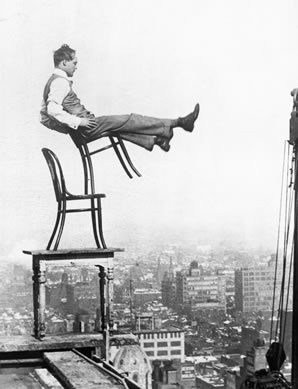

Fearless balance!
Static balance is the ability to balance while stationary. It’s what most people think of when they picture a balanced position. To be able to balance statically your body’s center of gravity must be lined up above your center of support. When standing on two legs, the center of support is the center point between your two feet. When standing on one leg, it’s at the center of the standing leg foot.
Let’s pause to spare a thought for our fearless balancer perched on two narrow chair legs to the right. Notice how his center of gravity, the point between the weight of his trunk leaning back and his legs stretching forward, lines up above the two back legs of the chair he’s sitting on. The heavier weight distribution of his trunk and head leaning back make up for the slight forward positioning of the lower chair and table.

Dynamic balance

Dynamic balance on the other hand, is the ability to balance while in motion or when switching positions. Your body is being affected by two forces, gravity and momentum, each one pulling you in different directions. In dynamic balance your inner balance sensors have to work harder to keep your center of gravity above your base. This is the main type of balance we use during movement in our daily lives.

Enhancing Sports Performance with Dynamic Balance Training
http://www.collegesportsscholarships.com/balance-training-athletes.htm

Balance and sports
While strength and cardio training are critical aspects of conditioning, balance is the foundation of good health, and everyone can improve their balance, regardless of ability, according to Louis Stack, a Canadian National Speed Skiing team member and balance training expert. In fact, some researchers suggest that the better you can balance, the less time you will need to spend increase your strength. “Balance conditioning is a way to train the body to make better use of the strength you already have,” says Stack. He suggests placing more emphasis on learning to move efficiently, with little wasted effort: “When you train someone for stabilization, proprioception and balance, by default he or she is at less risk for injury. Good balance reduces [the] need for additional effort.
“Balance is both a movement skill that enhances technique, and a conditioning element that can be improved. Another way to understand balance is as a function of the nervous system, which is directly influenced by the five senses. A sixth sense — proprioception — in the muscles, bones, hands, feet and connective tissues alerts the body when balance is threatened. The body’s balance centers — the eyes, ears and feet — work together to sense imbalance and help correct posture. Basically, the body’s ability to right itself (balance) is activated by stimulus: a response to an unexpected bump in the terrain, a sudden change in wind direction or an impulsive pass of the ball. Action in the canals of the ears detects abnormal tipping of the head in relation to gravity, and sends signals to the nervous system. When you lose balance, your brain sends instructions to the muscles and bones about how and when to react.
Balance training facilitates body awareness about the relationship of mass (hips) over the base of support (distance created between the feet or over one foot). While playing sports, this is a difficult thing to sense, but in a controlled training environment, these “feelings” can be introduced to athletes. The benefit is in “remembered” reactions to imbalance created in training situations. Balance awareness becomes an innate, automatic skill.

Sunday, October 1, 2017

Balance is key and easy to improve

My first blog post was about balance exercises.  Three years later, I'm still more likely to do something related to 1-leg balance every day than any other type of exercise.  A few minutes a day makes a difference after a month or two or three.  That's what I learned doing knee rehab for about four months.  Consistency matters.  Can do something to improve balance anywhere, anytime:  indoors, outdoors, waiting in line, watching TV, in the bathroom.

A very basic introduction to a few balance exercises (6 minute video)

Easy balance exercises that give a clear view of good form (9 minute video)

Wednesday, May 18, 2016

BOSU basics for ski conditioning

The first item I bought to use at home for knee rehab in 2012 was a BOSU®.  The BOSU is a half-dome balance trainer that can be found in many fitness centers.  I was using one for physical therapy pretty early in the process.  The key use then was to improve 1-leg balance for the injured leg.  Later on, I learned that there are lots of exercises using a BOSU that are good for skiing.

The following exercises were put together for a National Ski Patrol meeting several years ago.  As she mentions, a few of them are easy to do when watching TV.  Improving balance doesn't really take that much effort if you spend 5-10 min a day doing something.


Thursday, October 2, 2014

Improving dynamic balance with Tai Chi

There are a variety of ways to improve balance.  Using a BOSU is what I learned about during knee rehab a few years ago.  Even standing on one leg with eyes closed every so often makes a difference because it enhances what is called proprioception.  But that's a topic for another day.

Tai Chi is a great way to improve dynamic balance.  When doing Tai Chi, you are always moving.  What's different from western exercise routines is that the movement is slow and deliberate.  The slower the better sometimes.  Makes me think of the concept that when working on improving ski technique, being able to ski slowly and precisely on easy terrain is a way to ingrain skills that can then be used on harder terrain.

Lito Tejade-Flores learned to ski as an adult.  He went on to become an internationally known ski instructor.  I learned a lot from a couple of his well-known books.  In 2008 he wrote a blog entry that mentions how Tai Chi can really help someone's skiing.


Friday, September 26, 2014

First Blog Post . . . Ever! Improving Balance Takes Consistency

After sleeping on the idea for a while, maybe 5 years, I'm going to dip into the blogging world and see what happens.

My focus for ski conditioning this fall is on flexibility and balance, as well as improving cardio.  Getting stronger was relatively easy for me once I had a membership to a fitness center.  Doing exercises consistently to improve flexibility and/or balance takes more mental effort.

Here are links to a few videos related to balance, especially dynamic balance, which is most important when skiing.

Balance Training with progression

Exercises to Improve Dynamic & Static Balance